Product Navigation
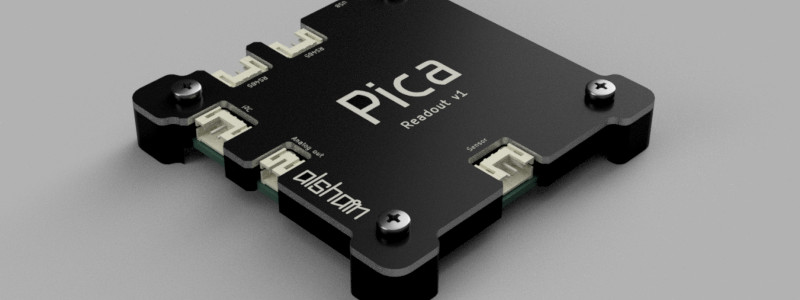
Summary
Real-time biomass monitoring and photometric measurementsThe Alshain Pica photometry system is a biomass‑monitoring platform designed for real‑time observation of microbial and cellular growth. As this includes yeasts, algae, bacteria, and other cell cultures, Pica is suitable for both research and industrial bioprocess applications.
Primary methods used to determine amount and optical properties of biomass are backscattering and absorption measurements. As biomass accumulates, the optical density of the medium changes accordingly. By continuously measuring these changes, the Pica system provides a non‑invasive estimate of biomass concentration throughout the cultivation process.
As measurements are taken continuously and automatically, the system enables real‑time monitoring of fermentation and other dynamic processes, such as sedimentation. Users can track growth curves as they develop, compute instantaneous growth rates, and detect early signs of growth stalls or process deviations. This makes the system particularly valuable for process optimization, early‑warning diagnostics, and automated control strategies.
In addition to biomass measurements, combining results from multiple sensors with different wavelenghts can be used to detect the presence of optically absorbing compounds in the culture medium. This allows users to identify metabolic byproducts, pigments, or other chromophoric substances that may appear during cultivation, providing additional insight into biochemistry of the process.
Common use cases are:
- Biomass monitoring
- Growth curves
- Process optimisation
- Reduces the need for manual sampling
- Photometric measurements
- Concentration data:
- Chlorophyll
- Carotenoids
- Other optically absorbing compounds
- Fluorecent marker media
- Turbidity
Specifications
Size, capabilities and cost
- Footprint: 75 x 75 x 13 mm, weight 45 g
- Power supply: 5 V, 30 mA peak when using standard sensor head, 15 mA when idling
- Connectivity: USB (virtual serial port), RS485 using ADAPT @ 460800 baud
- Readout operates as a USB↔RS485 gateway so many compatible devices can easily be daisy-chained
- Voltage ranges: ±1.024 V, ±0.512 V, ±0.256 V
- Typical noise equivalent number of bits: 20 bits ( 0.5Hz lowpass filter frequency )
- Pulsed measurements minimise effects caused by ambient light
- Up to 4 sensor heads can be connected using signal multiplexer
- Connectors: JST PH4 for sensor, I2C and RS-485 comms, JST PH2 for analog output and micro-usb for PC
- Designed and assembled in Espoo, Finland
>> Link to Pica Readout v1 datasheet.
Prices start from 1999 € + VAT and it can be purchased from our store or request a quote.
See also our installation and demonstration videos on YouTube and check out programming examples.

Overview
Pica photometry system consists of two main parts: the readout and a sensor head:
- Readout controls the sensor head, performs measurements and handles communications (usb and RS485)
- Sensor head contains optical emitter and receiver and is mounted to the bioreactor or similar vessel

Sensor head
Pica sensor head houses analog circuitry for optical receiver and transmitter:
- Emitter (LED), sends out the measurement beam, also determines at which wavelength sensor head operates
- Emitter is driven with temperature-compensated voltage-controlled constant current source
- Receiver (photodiode), measures light reflected or absorbed by cells and other particles in the liquid
- Photodiode is biased to provide highly linear response to incident light
- Amplifier gain is selected to maximise signal dynamic range for used wavelength

Temperature compensation
All measurement electronics (both digital and analog) are susceptible to temperature changes to a varying degree.- Sensor heads have integrated temperature compensation to mitigate this
- If utmost stability is required, Pica readout can compensate temperature effects even further in software
- More accurate temperature readings can be supplied to readout by computer
- Pica readout supports LM75-compatible I2C bus temperature sensors

Signal multiplexer, many reactors
Pica photometry system can be extended to many reactors either by daisy-chaining multiple readouts using RS485 (up to 32 units) or by adding a signal multiplexer between readout and sensor heads.- With multiplexer, a single readout can be extended up to 4 sensor heads
- Alshain Signal Multiplexer is controlled via RS485 and can be directly connected to Pica readout
- Tradeoff of using a multiplexer instead of multiple readouts is that measurements take more time as sensors are read one at a time

Signal multiplexer, multiple sensor heads per reactor
- Different wavelengths provide more information about the biochemistry
- Different positions gives insight about sedimentation and stratification (layer formation)

Multiple sensor heads, an example
Detecting changes in chlorophyll concentration can be achieved using two sensor heads:- 460nm sensor head, as chlorophyll A & B have strong absorption peaks between 400 and 500 nm
- 940nm sensor head for reference as it is not affected by presence of chlorophyll

Integration to industrial systems
Pica can be also be integrated into more traditional industrial setups using:- Software-adjustable analog output (voltage or current, depending on the model)
- Calibrations and other settings can be stored in non-volatile memory, no PC required after initial setup
- RS485 inteface with ADAPT protocol.
Code examples
More examples and documentation can be found here.Quick start guide with Python
import alshain
import serial

# replace "COM3" with corresponding port on your computer
com = serial.Serial( "COM3", alshain.BAUDRATE, timeout = 0.25 )

# Connect to Pica Readout with address = 1 (default)
dev = alshain.Pica( com, address = 1 )

# Enable photometer source
dev.write( alshain.Pica.Parameters.PULSE_ENABLE, 1 )

# Read results
print( dev.read( alshain.Pica.Parameters.RESULT ) )